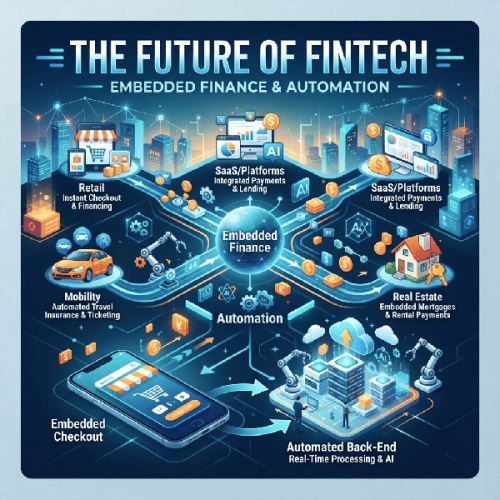
The financial technology landscape has shifted from isolated banking apps and experimental digital tools to deeply integrated, invisible infrastructure. Driven by the convergence of advanced automation and contextual financial services, Embedded Finance and Intelligent Automation are redefining how consumers interact with money and how enterprises handle capital.
1. The Maturity of Embedded Finance (Beyond the Basics)
Finance no longer lives solely inside banking applications; it is woven directly into non-financial platforms, making financial services a seamless, contextual layer of everyday digital experiences.
-
Contextual Ecosystems: Retailers, B2B software, supply chain portals, and enterprise platforms now natively offer banking features—such as instant checkout credit, integrated insurance, and working capital loans—precisely at the point of need.
-
The Shift in Value Chains: Non-financial brands own the customer relationship, while modular Banking-as-a-Service (BaaS) and API-driven enablers handle the heavy lifting behind the scenes. This drastically lowers distribution costs and opens up multi-billion-dollar revenue streams for software platforms.
-
Vertical Specialization: Embedded solutions are moving away from generic payment buttons toward complex, industry-specific workflows (e.g., automated invoice financing embedded inside ERP systems or freight-specific insurance embedded in logistics tools).
2. From Chatbots to Agentic AI Automation
Artificial intelligence has graduated from simple customer service scripts to autonomous execution, acting as active financial co-pilots and enterprise operators.
-
Autonomous Financial Execution: Next-generation AI models manage routine corporate cash flows, optimize working capital, negotiate transactional terms, and execute treasury strategies with minimal human friction.
-
Real-Time Risk & Compliance: Intelligent automation continuously monitors regulatory changes, pre-screens credit and KYC documents, and flags complex laundering rings using cross-institution network intelligence.
-
Hyper-Personalization: Consumer-facing fintech applications leverage real-time behavioural analytics to act as proactive financial advisors—anticipating liquidity gaps, automating savings rules, and dynamically adjusting product offerings based on user context.
3. The Backbone: Real-Time Infrastructure & Tokenization
The engine powering embedded finance and automation relies on immediate settlement rails and programmable money.
-
Real-Time Rails: Instant payment networks and cross-border routing bypass legacy batch-processing delays, enabling 24/7 liquidity and automated event-driven transactions.
-
Asset Tokenization: Real-world assets (such as bonds, invoices, and private equity) are moving onto programmable ledgers, blending traditional financial compliance with the speed and transparency of blockchain rails.
4. Strategic Imperatives for the Future
To capitalize on this evolution, modern fintech and enterprise roadmaps must focus on:
-
Modular Architectures: Building flexible, API-first stacks that allow new features and compliance protocols to plug-and-play without core rewrites.
-
Built-In Compliance (RegTech): Treating security, dynamic fraud scoring, and regional regulatory compliance as native structural foundations rather than secondary checkpoints.

krishna
Krishna is an experienced B2B blogger specializing in creating insightful and engaging content for businesses. With a keen understanding of industry trends and a talent for translating complex concepts into relatable narratives, Krishna helps companies build their brand, connect with their audience, and drive growth through compelling storytelling and strategic communication.