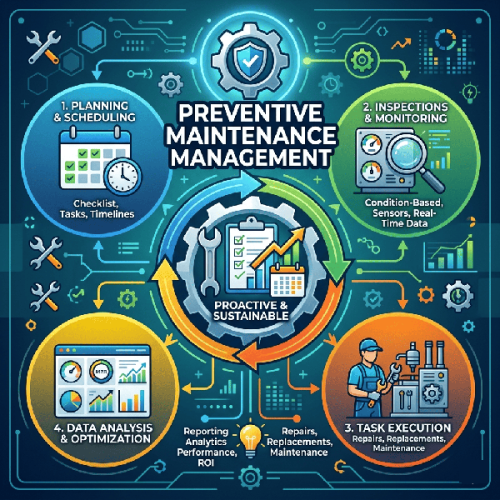
Preventive Maintenance (PM) is a proactive asset management strategy that involves scheduling regular inspections, servicing, and cleaning of equipment to prevent unexpected machinery failures.
Instead of waiting for a machine to break down—which stalls production and drives up repair costs—preventive maintenance aims to catch and fix minor wear-and-tear issues before they turn into major operational disasters.
The Core Concept: The P-F Interval
To manage preventive maintenance effectively, engineering teams rely on the P-F Curve, a visual representation of how an asset degrades over time.
-
Point P (Potential Failure): The specific moment a machine begins to show early, detectable signs of failure (such as a slight vibration, drop in oil pressure, or abnormal heat buildup).
-
Point F (Functional Failure): The point at which the machine completely breaks down and can no longer perform its intended function.
-
The P-F Interval: The window of time between Point P and Point F. The goal of a strong maintenance program is to detect the warning signs at Point P so technicians can schedule a repair safely within the P-F window, avoiding the catastrophic failure at Point F.
The 4 Pillars of a Preventive Maintenance Program
A comprehensive factory maintenance strategy balances multiple approaches to keep the shop floor running smoothly:
1. Time-Based Maintenance (Calendar PM)
Tasks are performed at fixed calendar intervals, regardless of how much or how little the machine has been used.
-
Examples: Changing HVAC filters on the 1st of every month, checking fire suppression systems semi-annually, or lubricating crane tracks every quarter.
2. Usage-Based Maintenance (Metered PM)
Tasks are triggered by specific operational benchmarks or machine meter readings. This is a much more accurate reflection of actual wear-and-tear than a calendar date.
-
Examples: Changing hydraulic oil every 2,000 running hours, replacing a conveyor belt after 50,000 operational cycles, or servicing transport forklifts every 5,000 kilometers.
3. Predictive Maintenance (PdM)
An advanced evolution of PM that utilizes industrial Internet of Things (IoT) sensors to monitor machine health in real-time. Instead of guessing based on time or average usage, repairs are scheduled only when live data signals an abnormality.
-
Key Techniques: Vibration analysis on rotating shafts, thermal imaging on electrical panels to detect overheating hotspots, and oil analysis to check for microscopic metal shavings.
4. Total Productive Maintenance (TPM)
A Lean manufacturing methodology that blurs the line between operations and maintenance. Under TPM, frontline machine operators are trained to perform daily, low-level maintenance tasks (like cleaning, fluid top-offs, and basic visual inspections) themselves, freeing up specialized maintenance technicians to focus on complex overhauls.

krishna
Krishna is an experienced B2B blogger specializing in creating insightful and engaging content for businesses. With a keen understanding of industry trends and a talent for translating complex concepts into relatable narratives, Krishna helps companies build their brand, connect with their audience, and drive growth through compelling storytelling and strategic communication.