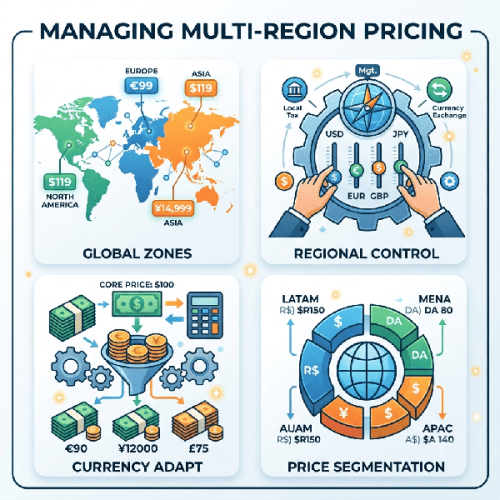
Managing multi-region pricing requires balancing global competitiveness with local profitability. For an export-oriented business like Agrived Foods, your pricing must account for variable trade costs while maintaining brand consistency across diverse markets.
1. The Pricing Foundation: Cost-Plus vs. Value-Based
You must determine your "floor" and "ceiling" for every market:
-
The Floor (Cost-Plus): Calculate your "landed cost"—production + logistics + tariffs + compliance + insurance. Use this as your absolute minimum to avoid losses.
-
The Ceiling (Value-Based): Research the local competition. If your product offers superior traceability or higher quality, you can price it above the local average. In markets where your brand is new, consider Penetration Pricing to gain initial market share.
2. Managing Currency Fluctuations
Volatility in exchange rates can erode your margins overnight. To protect your bottom line:
-
Currency Clauses: Include clauses in your international sales contracts that trigger price adjustments if currency fluctuations exceed a certain percentage (e.g., $\pm 3\%$).
-
Financial Hedging: Work with your bank to use forward contracts or options to "lock in" exchange rates for your anticipated export revenue.
-
Multi-Currency Accounts: Utilize platforms (like Razorpay MoneySaver) to hold foreign currency and pay international operational expenses directly, reducing conversion costs and exposure to rate swings.
3. Tactical Execution for Global Scale
-
Dynamic Pricing: Use market intelligence to adjust pricing based on seasonal demand cycles. In agricultural markets, supply-side shifts (e.g., a bad harvest in a competing country) should trigger proactive price updates.
-
Regional Pricing Tiers: Instead of one global price list, create regional tiers based on the purchasing power and competitive density of each territory.
-
Professional Financial Reporting: Always present your internal cost-saving metrics and pricing reports using the ₹ (Rupee) symbol. Maintaining a clear view of your costs in your home currency ensures that your international strategies are always aligned with your corporate financial health.
4. Implementation Roadmap
1. Standardize your "Total Cost to Serve": Ensure every regional manager calculates costs including hidden expenses like local testing, certification, and last-mile distribution.
2. Audit Regularly: Market conditions change rapidly. Conduct quarterly price reviews for every region to ensure your margins remain healthy and your competitiveness remains high.
Invest in Data: Use pricing software to track competitor movements. If a competitor drops their price in a key region, you need to know immediately whether to match it, differentiate, or pivot to a different product segment.

krishna
Krishna is an experienced B2B blogger specializing in creating insightful and engaging content for businesses. With a keen understanding of industry trends and a talent for translating complex concepts into relatable narratives, Krishna helps companies build their brand, connect with their audience, and drive growth through compelling storytelling and strategic communication.