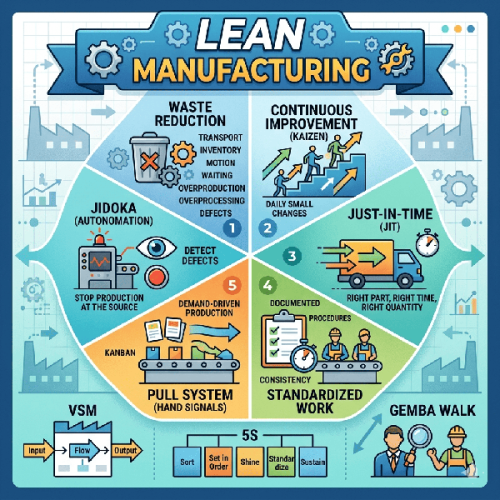
At its core, Lean Manufacturing is a systematic production methodology focused on a single, relentless goal: eliminating waste (Muda) while maximizing productivity and value for the customer.
Originally pioneered by Toyota through the Toyota Production System (TPS), Lean shifts the focus from managing isolated machines and departments to optimizing the flow of entire product streams.
The 5 Core Principles of Lean
To implement Lean effectively, organizations follow a continuous five-step thought process defined by Lean pioneers James Womack and Daniel Jones:
-
Define Value: Value can only be defined by the ultimate customer. What are they willing to pay for? Any activity that doesn’t add this specific value is waste.
-
Map the Value Stream: Identify every single step in the production process for a product. This map reveals actions that add value, actions that don't but are necessary, and actions that are pure waste (which should be eliminated immediately).
-
Create Flow: Ensure the remaining value-adding steps flow smoothly without interruptions, detours, or delays.
-
Establish Pull: Don't push inventory based on forecasts. Instead, let customer demand "pull" products through the manufacturing system. You only make what the customer orders, when they order it.
-
Pursue Perfection (Kaizen): Lean isn't a one-time project; it's a culture. It requires continuous, incremental improvements by every employee, every single day.
The 8 Deadly Wastes (DOWNTIME)
Lean categorizes non-value-adding activities into eight distinct types of waste. Remembering the acronym DOWNTIME is the easiest way to identify them on the shop floor:
-
D – Defects: Time, resources, and materials lost to scrap, rework, or incorrect documentation.
-
O – Overproduction: Making more of an item, or making it faster, than the customer actually requires. This is often considered the worst waste because it breeds all other wastes.
-
W – Waiting: Idle time spent waiting for materials, machine cycles, approvals, or information.
-
N – Non-Utilized Talent: Failing to leverage the skills, creative ideas, and problem-solving capabilities of the frontline workforce.
-
T – Transportation: Unnecessary movement of materials, parts, or finished goods between processes or facilities.
-
I – Inventory: Excess raw materials, Work-in-Progress (WIP), or finished goods sitting in storage. This ties up cash and hides underlying process problems.
-
M – Motion: Excess physical movement by operators (bending, lifting, walking, reaching) due to poor workstation layout.
-
E – Extra-Processing: Doing more work on a product than the customer requires or cares about (e.g., polishing a part that will be hidden inside a machine).
Essential Lean Tools and Practices
To target these wastes and smooth out production, Lean relies on a collection of practical tools:
1. 5S (Workplace Organization)
A structured methodology to organize the workplace for safety, efficiency, and visual control.
-
Sort (Seiri): Separate necessary items from unnecessary ones; remove the clutter.
-
Set in Order (Seiton): Arrange necessary items so they are easy to find, use, and return. "A place for everything, and everything in its place."
-
Shine (Seiso): Clean the work area and equipment to make abnormalities, like leaks or cracks, instantly visible.
-
Standardize (Seiketsu): Create visual standards and schedules to maintain the first three steps.
-
Sustain (Shitsuke): Build the discipline to keep the standard practice running long-term.
2. Just-In-Time (JIT) & Kanban
-
JIT is an inventory management strategy aimed at reducing in-process inventory and associated carrying costs.
-
It is driven by Kanban, a visual signaling system (often physical cards, bins, or digital boards) that triggers the production or movement of components only when a downstream process signals a need.
3. Poka-Yoke (Mistake-Proofing)
Designing a process or mechanism so that human errors are either impossible to make or are detected instantly. For example, a parts fixture shaped so an operator can only insert a component the correct way.
4. Standardized Work
Documenting the current best practice for a specific operation. This forms the baseline for consistency, ensuring every operator performs the task the same way, which makes any deviation or problem immediately obvious.
5. Value Stream Mapping (VSM)
A visual flowcharting tool used to illustrate, analyze, and improve the flow of materials and information required to bring a product to a customer.

krishna
Krishna is an experienced B2B blogger specializing in creating insightful and engaging content for businesses. With a keen understanding of industry trends and a talent for translating complex concepts into relatable narratives, Krishna helps companies build their brand, connect with their audience, and drive growth through compelling storytelling and strategic communication.