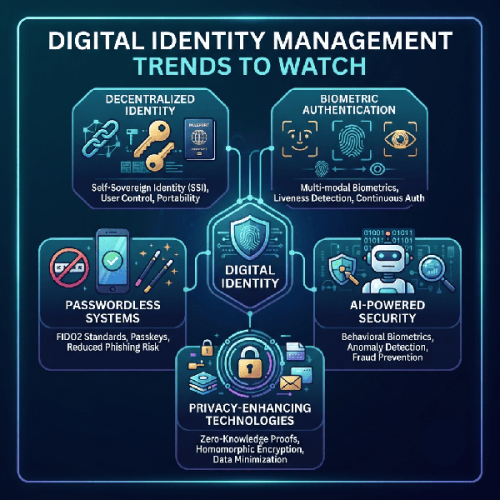
The landscape of Digital Identity Management (IAM) in 2026 has shifted from a focus on "tool expansion" to "practical, outcome-driven security". As identity becomes the primary attack surface, organizations are moving toward integrated, visibility-first strategies.
1. The Rise of "Agentic" Identity (Know-Your-Agent)
A significant shift in 2026 is the formal recognition of AI agents as participants in the identity lifecycle.
-
KYA (Know-Your-Agent): Organizations are beginning to treat autonomous AI agents like human users—requiring them to be registered, authenticated, authorized, and contained.
-
Purpose-Bound Credentials: To manage agent risks, identity systems are now issuing temporary, purpose-bound credentials that are automatically revoked upon task completion, with audit trails linking the agent’s actions back to a human owner.
2. Identity Visibility and Intelligence Platforms (IVIPs)
Fragmented environments across hybrid cloud and SaaS have created "blind spots" that attackers exploit. The industry is moving toward Identity Visibility and Intelligence Platforms (IVIPs).
-
Unified View: These platforms correlate human and non-human identities (NHIs) across all layers to uncover hidden risks, such as privilege creep or unauthorized access paths.
-
Continuous Evaluation: Success is no longer measured by static checkpoints but by data-driven signals demonstrating reduced attack surfaces and improved governance in real-time.
3. Non-Human Identity (NHI) Management
In many modern enterprises, machines (service accounts, API keys, workload identities, and IoT devices) now outnumber human accounts.
-
Governance-First Approach: Organizations are mandating that every NHI has a clear human owner to prevent "orphaned" credentials.
-
Secrets Management: Vaulting of secrets is becoming standard practice to eliminate hardcoded API keys and tokens in DevOps pipelines.
4. Maturity of Digital Wallets and Governance
Digital identity wallets are scaling globally under formal trust frameworks.
-
Selective Disclosure: These wallets allow users to prove specific attributes (like age or employment status) without sharing unnecessary personal data (like birth dates or full histories), enhancing both privacy and security.
-
Interoperability: Global standards and accreditation programs are emerging to ensure these wallets function securely across different sectors and borders.
5. Shift to Phishing-Resistant Authentication
Traditional passwords and OTPs are increasingly being phased out in favor of phishing-resistant, passwordless methods.
-
Biometric Edge Processing: Biometric verification is moving to the "device edge." Using zero-knowledge proofs and sensor attestation, devices can verify identity locally, keeping sensitive biometric data from moving across networks.
-
Hardening Recovery: Organizations are moving away from service-desk-driven recovery processes—often exploited via social engineering—toward more secure, automated, and self-service recovery workflows.

krishna
Krishna is an experienced B2B blogger specializing in creating insightful and engaging content for businesses. With a keen understanding of industry trends and a talent for translating complex concepts into relatable narratives, Krishna helps companies build their brand, connect with their audience, and drive growth through compelling storytelling and strategic communication.